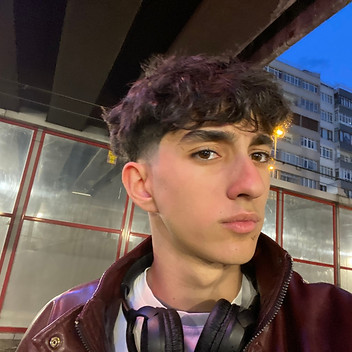
About Samet
I am a…
Student
I'm passionate about
Adults often say teenagers are lazy, distracted, or addicted to their phones.
But maybe the real problem is deeper:
Most teenagers today don’t know who they are supposed to become.
Social media constantly changes the definition of “cool.”
One week it’s looks.
The next week it’s money.
Then popularity.
Then fitness.
Then perfection.
Teenagers are growing up in a world where identity is no longer discovered slowly — it is performed publicly every day.
And because of that, many young people are not building a personality.
They are building an algorithm.
They change the way they dress, talk, think, and even dream based on what gets approval online.
But humans cannot feel mentally stable when their identity depends on reactions from strangers.
Maybe teenagers do not need another speech about discipline.
Maybe they need spaces where they can fail privately, think freely, and become themselves without being judged every second.
Because confidence is not created by likes.
It is created when a person finally feels comfortable being real.
An idea worth spreading
Most people grow up believing success is about managing time better.
Wake up earlier. Study longer. Work harder. Sleep less.
But time is fixed — everyone gets 24 hours.
Energy is what actually changes performance.
A student with high energy can learn in one hour what an exhausted student struggles to learn in five.
An athlete, artist, or entrepreneur doesn’t perform at their best because of time alone, but because they understand when their mind is most creative, focused, and motivated.
Imagine if schools taught:
* how sleep affects memory,
* how stress changes decision-making,
* how social media drains attention,
* how food and movement influence thinking,
* and how rest is not laziness, but recovery.
Instead of asking:
“How can I fit more into my day?”
people would ask:
“How can I protect the energy that makes my best work possible?”
The future may belong not to the busiest people,
but to the people who know how to manage their mental and physical energy the smartest.
The TED story
For a long time, I felt invisible.
Not physically invisible —
but invisible in the way people saw my potential.
People around me thought they understood me because they saw only a small part of who I was.
They saw my silence and called it laziness.
They saw my calmness and thought I had no ambition.
They saw my current situation and assumed it was my final form.
But what hurts the most is not failure.
It is knowing you carry something bigger inside yourself while nobody else can see it yet.
There is a strange loneliness in having dreams you cannot fully explain.
You start imagining future versions of yourself in secret:
* the person you want to become,
* the life you want to build,
* the respect you want to earn,
* the moment people finally realize they underestimated you.
And maybe that feeling is not arrogance.
Maybe it is hope.
Because many successful people were once ignored people.
Many confident people were once doubted people.
Many extraordinary stories started with someone quietly thinking:
“Just wait. I’m not finished yet.”
I think one of the most powerful moments in life
is when the world finally sees what you believed about yourself all along.
Things you might not know
Some people grow up with constant support.
Their talents are noticed early.
Teachers praise them. Friends admire them. Family believes in them.
But many others grow up differently.
They know they have potential, ideas, creativity, or intelligence —
yet nobody around them truly sees it.
And after a while, something painful happens:
You stop trying to prove yourself.
Not because you are weak,
but because being underestimated every day becomes exhausting.
There are students who are called “average” while hiding incredible creativity.
Quiet people mistaken for unconfident people.
Teenagers with big dreams who never speak about them because they are afraid others will laugh.
The world often notices loud talent first.
But some of the greatest abilities grow silently.
Maybe the problem is not that people lack talent.
Maybe the problem is that many talented people never receive the environment needed to reveal it.
Imagine how many future artists, leaders, inventors, or entrepreneurs are currently sitting in classrooms thinking:
“Nobody really knows what I’m capable of.”
Sometimes, the biggest change in a person’s life is not success itself —
it is finally being seen correctly.