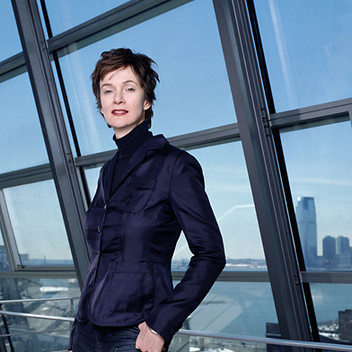
Winka Dubbeldam
Professor and Chair of the department of Architecture at the Uni at Principal Archi-Tectonics
TED Attendee
New York, New York, United StatesAbout Winka
Bio
Archi-Tectonics NY/NL
Firm History
Winka Dubbeldam is the principal of Archi-Tectonics NY [1994] and Archi-Tectonics NL [1997]. As of October 2007 Architectonics was re-structured and expanded its capacity. Today Rob van Houten [NL] makes up the new managing face of Archi-Tectonics together with Winka Dubbeldam. Dubbeldam is a graduate of the Academy of Architecture in Rotterdam [1990], and received a second Masters Degree in Advanced Architectural Design from Columbia University, NYC [1992]. She has lectured and taught extensively at the Masters Programs of Columbia, NYC and Harvard, Cambridge and currently holds the position of Chair and Professor at the department of architecture at PennDesign, Philadelphia. She serves as juror in International design competitions, such as the Prix de Rome, and as the External Examiner for the Architectural Association in London. Winka has recently joined the Board of Directors of the Institute of Urban Design, NY and of Boffo [2010].
Philosophy
Archi-Tectonics is a research based design practice with a focus on development, a philosophy based on combining the theoretical with the pragmatic, research with construction. While our designs attempt to achieve efficiencies that express themselves in optimal modulation, these efficiencies are also expressed in energy-efficiency and sustainable solutions, Archi-Tectonics is an expert in LEED design. Archi-Tectonics' work ranges from residential to commercial, from real to virtual and is realized in urban designs, buildings, and museums. Recent built work includes the 80,000sf Greenwich building, NYC, the 15-story American Loft tower in Philadelphia, the 2500sf GT residence & guesthouse Upstate NY and the 3000 sf DUB-residence in Holland, the 9-story residential Vestry building, the Brewster Carriage House, a mixed-use building in NYC, a townhouse in Chelsea, NYC for a fashion designer, the Flagship stores for PORTS1961 in London, Paris and Shanghai, and a school / orphanage in Liberia Africa. Current work are a Hotel on Staten island , NYC, design-research for Downtown Bogota, and several mixed use developments in Xian and Yulin, China
Publications include the three Monographs, "Winka Dubbeldam, Architect" [010 Publishers, Rotterdam, 1996], the "AT-INdex" [Princeton Press, NYC, 2006], and the "Archi-Tectonics Monograph" [DAAB publishers 2010], and the work has been published in a large number of International Periodicals. Solo exhibitions include installations in Form Zero Gallery in Los Angeles (1994), the Kunsthal in Rotterdam (1996), ËœFrom HardWare to SoftForm" in the Frederieke Taylor Gallery [Chelsea, NY, 2002] and the Art & Idea Gallery in Mexico City (2004).
Archi-Tectonics was a participant in the MOMA exhibits, "The Unprivate House" (1999) and the "Young Architects" (2001), and participated in the Max Protetch Exhibit for proposals for the WTC (2001), which was also featured at the Venice Biennale [2002] . Archi-tectonics also participated in the Venice Biennale "Arsenale exhibit" in 2004. Dubbeldam is the curator of the PAN [Progressive Architecture Network] exhibit in the Taylor Gallery Oct-Nov 2006
Winka received the "Emerging Voice" award [2001], and Archi-Tectonics was the Award winner in the IIDA / Metropolis Smart Environments Award [2006], and Archi-Tectonics recently won the Design Competition for a Sustainable Neighborhood and Farmers Market on Staten Island, NY, and the Yulin Art District, China [4,5 million sf]
I'm passionate about
We work probono on several projects, among which the MCF academy; a school / orphanage for 200 Liberian orphans in Monrovia for the Macdella Cooper Foundation in NYC
An idea worth spreading
The understanding of architecture as "meaning-form" is a departure of an architecture, which used to define itself in style or form, into an architecture as process.- is the development of a proper theory of complex systems that will be the capstone to this transition from the material to the informational, Â says John L. Casti, in his book "Would-be Worlds"
A generative architecture learns from the intelligence of Industrial design, which is always reactive to, and an integral part of, new production systems and material qualities. Product development integrates performative studies, marketing analyses and rapid prototyping. The formal investigations are here no longer the aesthetic ideal, or style. We are not interested solely in form, but ultimately in the per-formance of the space, which results in its modulation.
Areas of expertise
Architectural Design, architecture, art, teaching
The TED story
Since its conception in 1994, Archi-Tectonics has operated as a laboratory based on research and design, a philosophy, which combines the theoretical with the pragmatic, research with construction. Essential is that the computer is used as a generative tool rather than a representational or technical device. The interest here lies not in purely abstract formal expressions, but in surface registrations of force fields, smart systems, and programmatic mappings. Mathematics, already in the 1830s, understood that absolute values are relative to behavioral states, and developed a system-based theory studying complexity and higher-dimensional topology. The generation of per-formative modulations and surfaces is facilitated by the use of generative software, which translates behavioral patterns, reflected in the sequential differentiation of spatial modules as intelligent registrations. They are distilled in a set of smooth surface deflections, or optimized organic modulations.
Things you might not know
sculpture, welding, writing, architectural theory