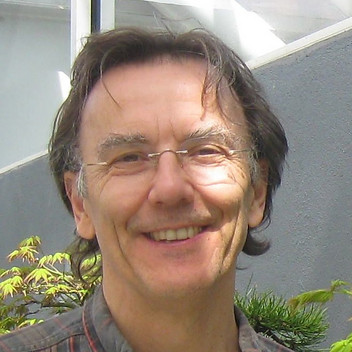
Peter Cornillon
Physical oceanographer at University of Rhode Island
TED Attendee
Narragansett, Rhode Island, United StatesAbout Peter
I am a…
Agnostic, Brainstormer, Concerned citizen, Educator/Teacher, Entrepreneur, Idea generator, Parent, Scientist, Technologist
Bio
I received my doctoral degree in Experimental High Energy Physics from Cornell University in 1973. I have however been working as a satellite oceanographer since 1981. My areas of interest in physical oceanography range from the large scale, e.g., subtropical gyre circulation, to the small scale, e.g., frontal dynamics in the open ocean and on the continental shelf. My research projects make use of data from a number of satellite-borne sensors.
I have also worked for the past 15+ years on distributed data systems, specifically, on the internet access to binary data.
Recently, I have been funded by the University of Rhode Island to run their 2011 Honors Colloquium. The focus of the 2011 colloquium will be on how technology is likely to change our futures.
I'm passionate about
The need to for us to think more carefully about the future given the likely staggering changes that we are going to see in our lives over the next 20+ years resulting from advances in technology.
An idea worth spreading
Our ability to address scientific issues depends on how a given field fits into what our brains are good at. We have evolved to deal with objects in 4 dimensions - a stone thrown at us. Our brains are good a processing such information. Think about an outfielder in baseball. At the crack of the bat the outfielder is running in the right direction often making a spectacular diving catch. To do so he has had to do a significant amount of processing. Now think of the oceanographer who is trying to understand the separation of the Gulf Stream from the continental margin. This problem deals with a fully 4D field - not just a particle in 4D - and it is very hard for us to wrap our brains around it. We have not evolved to deal with 4D fields - yes air is one, but we don't see the air and it has only a small impact on the trajectory of a rock for example. The particle physicist, although dealing with a 4D field can often visualize processes in the context of particles.
Areas of expertise
Distributed data systems, Physical Oceanography, Satellite Oceanography
Things you might not know
--- neither do I.