About Jhanak
I am a…
Artist, Connector, Journalist, Student
Bio
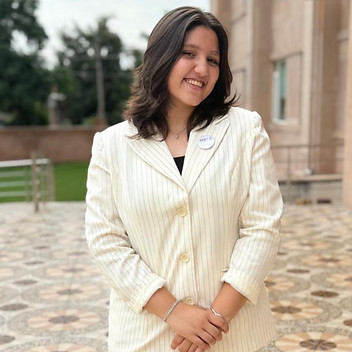
Hi, I'm Jhanak, A Levels student, ex Head Girl, serial debater, occasional bossy-but-loving team leader, and someone who's never met a microphone she didn't want to hold.
I've spent the last few years bouncing between Model UN conference halls, debate podiums, and event-planning chaos, co-founding the Dialectic League at my school, picking up wins from Kazakhstan to IIT Bombay, and somehow ending up speaking at the G20 Summit, on a panel at the UN Youth Summit, and on the TEDx stage. I also co-founded Student Impact Lab, where our 60+ member team has trained over 300 government school students in interpersonal skills and personality development, because I genuinely believe confidence is something you can teach.
When I'm not arguing a point I don't actually disagree with (occupational hazard of being a debater), I'm probably writing poetry, doodling something in the margins of my notebook, or directing my latest project, a documentary on the Bhogishail Parikrama, which I just wrapped after what felt like a hundred reshoots.
I'm empathetic to a fault, ridiculously hardworking, and yes, a little bossy. But I get things done. Beautifully. And on time.
I'm passionate about
I'm passionate about taking something conventional and asking why it has to stay that way. Not wedding, I think about corporate rooms, formal meetings, the spaces everyone shows up to out of obligation, and what it would take to make someone actually want to be there. That's where creativity, persuasion, and leadership stop being separate skills and start being one job: designing an experience, pitching the vision, getting a room of people to buy in, then making sure the small logistical details don't quietly wreck it. I'm drawn to building things that don't exist yet, and to the unglamorous, 1 a.m., forty-seventh-detail work that nobody applauds, because that's the part that tells you whether you actually love it.
An idea worth spreading
We live in a world optimized for clarity, for the fact, the headline, the explicit takeaway. Journalism gave me that instinct first: say the thing plainly, get to the point, don't make the reader work for it. And we need that. Clarity is how a society agrees on what's true.
But I've spent years living in two other rooms at the same time. One is a debate stage, where I learned to close every gap in an argument until nothing could slip through. The other is a page, where I write poetry that does the opposite on purpose, that leaves gaps, that hides before it reveals, that trusts a reader to sit with not-knowing for a moment longer than they'd like.
For a long time I thought these were contradictions. The arguer and the poet. The one who wins the room and the one who won't even tell you plainly what a line means. People who meet me on a stage expect the first version, sharp, certain, hard to move. They're often surprised by the second.
But I don't think they're contradictions anymore. I think they're the same instinct, aimed in two directions.
Here's what I mean: the most persuasive line, on a debate floor or inside a poem, is rarely the most explicit one. It's the one that makes the listener finish the thought themselves. When you hand someone every conclusion pre-chewed, you're not really talking to them, you're talking at them. But when you leave the right gap, something else happens: the listener has to bring themselves into the sentence to complete it. And once they've done that, the idea isn't just yours anymore. It's theirs too.
That's not evasion. That's respect. It's the difference between telling someone what to feel and trusting them to arrive at a feeling on their own terms.
I think of this as ambiguity done well, not vagueness, not confusion, but a deliberate, crafted space where meaning isn't handed over, it's invited in. Poets have always known this. Debaters, oddly, know a version of it too, the best arguments don't just state their conclusion, they build a structure the audience walks through until the conclusion feels self-arrived-at, inevitable, theirs. Journalism knows a third version, the fact placed without commentary, trusting the reader to feel its weight.
Different crafts. Same quiet act of faith in the person on the other end.
Here's the second half of the idea, and the part I think matters more: holding space for that kind of ambiguity, in public, takes a spine. Softness without the ability to defend it gets flattened almost immediately, by louder voices, by the demand for hot takes, by a culture that treats "just tell me straight" as the only honest register. If you're going to insist on nuance in a world that keeps asking you to pick a side and say it loud, you need to be able to hold your ground while you do it.
So maybe what looks like "harsh and bold" was never the opposite of sensitive. Maybe it's the thing standing guard in front of it, the debater's spine, protecting the poet's gap, so the gap has room to survive contact with the world.
That's my idea worth spreading: that ambiguity, when it's crafted rather than careless, is one of the most empathetic tools we have, because it's the only kind of communication that doesn't just inform the listener, it involves them. And protecting that kind of communication, especially now, takes exactly the kind of boldness people assume is its enemy.
We don't actually have to choose between clarity and depth, between the headline and the poem, between being unshakeable and being gentle. The strongest version of any of us might be the one holding all of it at once ,plainspoken when the moment needs a fact, and unafraid of the gap when the moment needs a feeling to be found, not delivered.
Areas of expertise
and how they actually think, and I think that combination is rare: most people are trained toward one register (the emotional/creative or the analytical/structural), and I've deliberately built fluency in both.
What ties it together is a single instinct: read the room, and I've spent years getting fluent in all three at once.
Debating & the psychology of persuasion. Years on competitive stages taught me more than how to win an argument, and incentives, because I think the unsaid line often does more emotional work than the said one.
Empathy as observation. I'm told I come across as the most vocal person in a room and, before you speak into it. Debating gave me the confidence to speak first. Everything else taught me why it's often smarter not to., but as a study of how minds move.
Poetry & language as feeling, but because I've learned that giving someone room to open up first tells me more than anything I could say to open them up myself. Harsh on the outside is often just armor built to protect a fairly soft, composition, how systems actually behave, how they create, it sits in the space between how people argue, it's method. I notice people before I engage them: how they hold a pause, just without words.
Math & economics. The counterweight to all of the above. Where poetry and empathy deal in the unmeasurable, logic, math and economics ground me in structure, misdirection, My expertise doesn't sit neatly in one lane, non-verbal version of the same instinct, not as a party trick, not because I'm distant, not information. Where debating deals in explicit conclusions, not just how people feel about them. I'm as comfortable inside a model or a spreadsheet as I am inside a stanza, over-noticing interior.
Painting. A quieter, paradoxically, poetry is where I work in implication, restraint, restraint. I write things that don't explain themselves, the argument, the canvas, the exact moment you let them feel like the conclusion was theirs. I understand influence at a structural level, the most detached. That's not disinterest, the numbers, the poem, the timing, they taught me how belief actually forms in someone else's mind. What makes a person change their position isn't usually the strongest fact; it's the sequencing, what they don't say, what they're bracing for. I hold back deliberately, what you choose to leave out of a canvas so the eye finishes it. It trains the same muscle poetry does, word play
The TED story
What lasts longer: a smartphone without a charger, a packet of chips, or a handwritten love letter? In modern society, we have normalized designing products to expire. Consider an expired plastic credit or debit card sitting unused in a drawer. The magnetic stripe still functions, yet an arbitrary printed date declares it dead. Multiplied across millions of households, this system of planned obsolescence transforms usable tools into centuries of non-degradable waste. We buy, we swipe, and we wipe off, a linear cycle where design creates expiration rather than sustenance.
My journey to challenging this linear paradigm began in my hometown of Jodhpur, Rajasthan. Every three years, thousands of people perform the Bhoogi Shell Parikrama, circumambulating an ancient, million-year-old hillock. Documenting this ritual in 2023 revealed a profound realization: this was not merely an act of faith, but a masterclass in circular design. The ritual protects local biodiversity, the ecology sustains the local economy, and the community preserves the tradition. Culture and nature exist in an infinite symbiotic loop representing planned sustenance, harnessing the infinite resource of the human spirit to design for true regeneration.
Driven by this concept of Eco Karma, that what we design inevitably returns to impact us, I launched the Pays Go Green campaign. I petitioned for tech-driven, circular alternatives to short-lifespan plastics, questioning why we manufacture plastic to endure for centuries if we force it to expire in two to five years. This initiative gained global resonance, earning recognition from the United Nations Environment Programme (UNEP) in 2025 and leading to an invitation to present at the G20 Chief Scientific Advisers Roundtable at IIT in 2023.
To shift from a linear to a circular mindset, my work introduces a practical framework for circular design. Every system requires three sets of resources: resources to manufacture, resources to maintain operation, and resources to regenerate. Beyond standard design metrics like viability, feasibility, and desirability, true circular design must embed longevity by maximizing utility per resource, alongside reversibility to ensure the system remains restorative throughout its lifecycle.
Returning to my opening thought experiment, a smartphone without a charger becomes a useless brick through planned obsolescence, while a chip packet lasts over a century as toxic, non-evolving waste. An old love letter, however, continues to regenerate emotion, meaning, and connection across generations long after its writer is gone. That love letter represents circular design in action,an idea that respires rather than expires. My mission within the TED community is to advocate for design that flows like rivers of renewal, building a future anchored in circularity, ecological responsibility, and regenerative purpose.
Things you might not know
People meet me across a debate podium first, sharp, unflinching, built to argue a point until it doesn't wobble anymore. That's the version they expect every time after.
What they don't see is the other room I live in: where I write poetry that refuses to explain itself. I'm drawn to the sentence that hides before it reveals, the metaphor that makes you sit with not-knowing for a second longer than you'd like. My poems aren't built to win, they're built to unsettle, gently. Wordplay as a way of feeling through something, not arguing it.
I think the two aren't in conflict. Debating taught me precision; poetry taught me restraint. One sharpens the blade, the other decides when not to use it.
I'm here because I think ideas don't only travel best when they're loud and certain, sometimes they travel best folded into a line you have to read twice. I want to bring that instinct to a stage that mostly hears the other one.