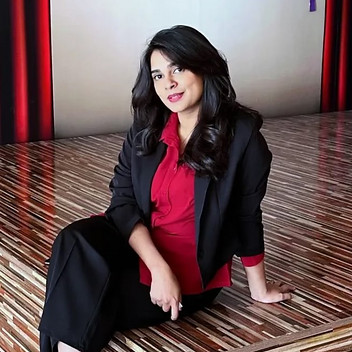
About Maham
I am a…
Artist, Educator/Teacher
Bio
I am Maham Khan, an education leader driven by one unwavering belief: education should empower people to face the world, not simply prepare them for examinations.
Throughout my journey as a teacher, trainer, academic leader, and programme head, I have witnessed education's greatest strength extend far beyond classrooms. Inspired by Maria Montessori's belief that "the environment is the third teacher," I have dedicated my career to creating learning environments where confidence, curiosity, and character are cultivated alongside academic excellence.
My leadership philosophy has never been about authority; it has been about enabling people. Whether mentoring struggling students, training hundreds of educators, or designing academic systems that improve learning outcomes, I believe transformation begins when individuals are trusted to recognize their own potential.
As a young woman entrusted with leadership roles early in my career, I often found myself managing teams older than me, navigating assumptions about age, gender, and credibility. These experiences shaped my conviction that leadership is neither inherited through age nor defined by gender—it is earned through competence, empathy, consistency, and courage.
Today, my work extends beyond educational administration. I am passionate about creating institutions where educators thrive, students develop purpose alongside knowledge, and women feel empowered to lead without first seeking permission.
I'm passionate about
I am passionate about redefining what educational leadership looks like in the twenty-first century.
For generations, education has been measured through grades, compliance, and examination results. While academic achievement matters, I believe schools have a far greater responsibility: to develop confident, ethical, resilient human beings who are equipped to navigate an increasingly complex world.
I am equally passionate about the role women play in shaping this future. Education remains one of the few professions largely sustained by women, yet leadership within educational institutions often continues to reflect outdated assumptions about authority. I want to challenge the belief that women are naturally nurturers but exceptional leadership belongs elsewhere.
Over the years, I have had the privilege of mentoring and training more than 500 educators, helping them discover confidence in their classrooms, strengthen their professional identity, and recognize that teaching is not simply a profession—it is leadership in its purest form. Every empowered educator creates hundreds of empowered learners, creating a ripple effect that reaches far beyond a single classroom
An idea worth spreading
The future of leadership is being shaped in today's classrooms—and women must help define what that leadership looks like.
John Dewey argued that education is not preparation for life; education is life itself. Yet many educational systems continue to reduce learning to examinations, rankings, and standardized measures of success.
I believe education must become something far greater.
Every classroom quietly teaches children what leadership looks like. When students experience empathy alongside accountability, collaboration alongside excellence, and courage alongside compassion, they develop a new understanding of what influence truly means.
Likewise, every workplace teaches women what leadership allows them to become. Too often, women are encouraged to remain agreeable rather than influential, empathetic rather than authoritative. I believe empathy should strengthen leadership, not diminish it.
One lesson I wish every young woman entering the workforce understood is this:
There is a fine line between being empathetic and being taken advantage of.
Leadership does not require permission. It requires preparation, conviction, and the willingness to keep showing up even when your voice is questioned.
If we can create schools where students grow into confident individuals and workplaces where women are encouraged to lead authentically rather than imitate traditional leadership models, we will not simply educate better generations—we will reshape society itself.
Areas of expertise
Educational Leadership
Teacher Development & Professional Learning
Curriculum Design & Quality Assurance
Women in Educational Leadership
Learning Environment Design
Institutional Growth & Academic Strategy
Student Development & Well-being
The TED story
I often think about a sentence spoken to me years ago by one of my teachers.
"You have the tendency to do something big. Don't stop until you do it."
At the time, it sounded like encouragement.
Years later, I realize it became responsibility.
That single belief changed how I viewed my own potential. It inspired me to pursue leadership not because I wanted a title, but because I understood the profound impact one person can have when they choose to believe in someone else.
Since then, every role I have accepted—from classroom teacher to programme leader—has been guided by one question:
How can I create environments where others begin believing in themselves?
I have watched struggling students discover confidence, introduced systems that transformed academic practice, led accreditation processes, designed educational programmes, and mentored hundreds of teachers who now inspire thousands of learners.
My story, however, is not about professional milestones.
It is about challenging quiet assumptions.
The assumption that young women must wait before they lead.
The assumption that kindness is incompatible with authority.
The assumption that education ends with grades.
Every experience has reinforced my belief that leadership begins long before someone receives a title. It begins the moment we choose to elevate another person's potential.
That is the story I hope to share.
Things you might not know
Beyond education, I am also an artist and painter. Over the years, I have held two solo art exhibitions, using visual storytelling as a way to explore emotion, identity, and the human experience.
For me, art is more than a creative pursuit—it is a form of catharsis. It provides a space where emotions that cannot always be articulated through words find expression through colour, texture, and form. Just as education empowers individuals to discover their voice, art allows them to process it.
This belief has deeply influenced my leadership philosophy. Every learner, every educator, and every individual carries stories that deserve to be understood before they are evaluated. Creativity nurtures empathy, and empathy builds stronger leaders.
Whether I am designing learning environments or standing before a canvas, I am ultimately doing the same thing: creating spaces where people feel seen, heard, and empowered to become the fullest version of themselves.
I believe the most meaningful education is found where academics, creativity, and humanity intersect, because while knowledge informs the mind, art has the remarkable ability to heal the soul.