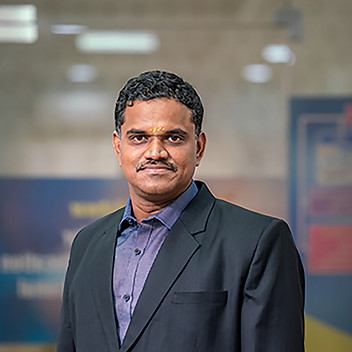
About Vimal
I am a…
Educator/Teacher, Technologist
Bio
Dr. S. Vimal is a distinguished academic and researcher with Nineteen years of teaching and research experience. He holds a Post-Doctorate from the Federal Institute of Science and Technology, Brazil and Ph.D. in Information and Communication Engineering from Anna University, Chennai. He is recognized as a leading expert in Artificial Intelligence, Game Modelling, Cognitive Radio Networks, Machine Learning, and Big Data Analytics. He is a EMC Certified Data Science Associate and CCNA-certified professional. He has published 173 papers in reputed journals, including 105 SCI/SCIE-indexed journals. He is also the editor of three books with IGI Global, USA, and CRC Press, and has hosted 28 SCI special issues as Lead Guest Editor for IEEE, Elsevier, Springer, Wiley, and Tech Science. His contributions to the field have earned him a place on Stanford University’s Top 2% Scientist list for 2022, 2023 and 2024 in AI, and the International Young Scientist Researcher Award by I2OR for 2019, 2020, 2022, and 2023. He holds six Korean patents and five Indian patents along with two granted copyrights. He has organized 17 funded seminars, workshops, and FDPs worth INR 17,00,000, funded by AICTE, DST, DBT, ISTE, INAE, ICSSR, and Anna University. He has hosted five special sessions at IEEE conferences in Thailand, Japan, and Osaka, and has extensive research collaborations with eminent professors from the USA, France, Korea, Australia, Turkey, Malaysia, and Middle Eastern countries. As a senior member of IEEE and ISTE, Hel serves on the editorial board of three SCI-indexed international journals and reviews for 76 SCI-indexed journals and Editor for Springer Flagship international conferences. He is a Visiting professor for two reputed universities in Singapore, Vietnam and USA. His expertise in AI, Machine Learning, Big Data Analytics, and Network Security, evidenced by high-impact publications and funded workshops, makes him an invaluable asset in advancing the Computing stream and driving innovation.
I'm passionate about
I am passionate about transforming knowledge into impact. As a researcher, educator, mentor, and innovator, I find immense satisfaction in solving real-world problems through Artificial Intelligence, Machine Learning, Data Science, and emerging technologies.
My passion extends beyond publishing research papers or developing algorithms. I am deeply committed to nurturing the next generation of innovators by creating opportunities for students, researchers, and young professionals to engage with cutting-edge technologies. Whether organizing funded workshops, mentoring scholars, collaborating across continents, or building interdisciplinary research networks, I am driven by the belief that knowledge becomes meaningful only when it empowers others.
I am particularly fascinated by how AI can address global challenges in healthcare, communication, sustainability, smart infrastructure, cybersecurity, and education. The intersection of technology and human development excites me because it offers endless possibilities to improve lives.
What motivates me every day is the opportunity to learn, create, and contribute. I believe that curiosity fuels discovery, collaboration accelerates innovation, and education remains the most powerful tool for societal transformation. My lifelong mission is to bridge the gap between advanced research and practical impact, ensuring that technological progress benefits people across all sections of society.
An idea worth spreading
Artificial Intelligence should not be viewed as a technology that replaces human intelligence; rather, it should be seen as a catalyst that amplifies human potential. The most transformative innovations emerge when machines and humans collaborate, combining computational power with creativity, ethics, empathy, and critical thinking.
Throughout my academic and research journey, I have witnessed how AI has evolved from a theoretical concept into a force that influences healthcare, education, communication, governance, and industry. Yet, the greatest challenge of our time is not developing more intelligent machines—it is ensuring that intelligent technologies serve humanity responsibly.
My idea worth spreading is that the future belongs to "Human-Centered AI"—an approach where innovation is guided by ethical responsibility, inclusivity, sustainability, and societal impact. AI should empower students to learn better, researchers to discover faster, doctors to diagnose more accurately, and communities to solve complex challenges. The question is not whether AI will shape the future; it already is. The question is whether we will shape AI with wisdom, purpose, and values.
I believe every educator, researcher, policymaker, and innovator has a role in building an AI-enabled future that enhances human capability rather than diminishing it. By placing people at the center of technological advancement, we can ensure that innovation becomes a force for collective progress and meaningful change.
Areas of expertise
Artificial Intelligence (AI), Data Science and Big Data Analytics, Generative AI and Intelligent Systems, Machine Learning and Deep Learning
The TED story
My journey began not in a state-of-the-art laboratory but with a simple curiosity about how technology could solve complex human problems. As a young academic, I was fascinated by communication systems, intelligent networks, and the emerging possibilities of artificial intelligence. What started as curiosity gradually evolved into a lifelong pursuit of knowledge, innovation, and impact.
Over nearly two decades, I have experienced the highs and lows that every researcher encounters—failed experiments, rejected manuscripts, long nights of research, and countless moments of uncertainty. Yet, each setback became a lesson, and each challenge strengthened my determination to contribute meaningfully to science and society.
One of the defining moments of my journey was realizing that research is not merely about publishing papers; it is about creating knowledge that inspires others and solves real-world problems. This perspective led me to collaborate with researchers across multiple countries, mentor students, organize funded academic initiatives, and contribute to global conversations on AI and data-driven technologies.
Being recognized among Stanford University's Top 2% Scientists and receiving international research awards has been deeply humbling. However, the most rewarding moments are not the accolades—they are the success stories of students, young researchers, and collaborators whose lives and careers have been positively influenced through shared learning and mentorship.
My TED story is ultimately about perseverance, curiosity, and purpose. It is a story of how continuous learning, global collaboration, and a commitment to helping others can transform individual aspirations into collective impact. Through science, education, and innovation, I have learned that meaningful success is measured not only by what we achieve but by how many people we empower along the way.
Things you might not know
Most people know me through my research publications, patents, conferences, and academic achievements. What many do not know is that one of my greatest strengths lies in connecting people, ideas, and opportunities.
I enjoy identifying potential in students and researchers long before they recognize it in themselves. Mentoring, motivating, and helping individuals navigate their academic and professional journeys is something I genuinely value. Many successful projects and collaborations have begun through simple conversations where I encouraged someone to pursue an idea they initially doubted.
I am also skilled at building international research collaborations across diverse disciplines and cultures. Bringing together experts from different countries, backgrounds, and areas of expertise to solve complex problems requires communication, empathy, and relationship-building—skills that are often overlooked in scientific careers.
Beyond academics, I enjoy simplifying complex concepts and making advanced technologies accessible to broader audiences. Whether explaining AI to students, guiding young researchers, or designing learning experiences, I believe that the ability to communicate knowledge clearly is just as important as generating it.
In many ways, my hidden strength is not just creating research—it is creating environments where innovation, collaboration, and people can thrive.