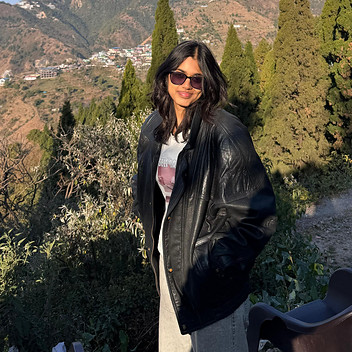
About Sanyukta
I am a…
Concerned citizen, Student
Bio
I’m a third-year Economics and Finance student driven by curiosity, both inside and outside the classroom. I love trying new things, collecting hobbies, and learning from people with perspectives different from my own. My fascination with ideas began early, when I stumbled upon a TED Talk on my mom’s phone as a child. Since then, TED has become more than just a platform I watch; it has shaped how I think about stories, innovation, and meaningful conversations. I may not have every detail of my future mapped out, but I know I want to keep learning, challenging myself, and enjoying the process of getting there.
I'm passionate about
I am an Economics and Finance student, and I am definitely passionate about it. From multiple internships in finance to research in macroeconomics, I feel like I have struck the perfect balance between today’s capitalist and socialist divides.
Literature has always been one of my greatest passions in life. My shelves are full of science fiction novels and gothic classics that I grew up reading. Inspired by Poe, I even took up writing poetry and short essays.
Apart from academics, I love everything and anything related to music. I loved picking up different instruments, learning to dance, and even pursuing 4 levels in Indian classical music.
I also enjoy travelling to new places and discovering their local beverages. As a coffee and tea enjoyer, I love discovering how each place customises the normal flavours to make it their own.
An idea worth spreading
Algorithms Are Becoming Our Editors
Every day, we consume an overwhelming amount of information. We like to believe we're choosing what to read, watch, and learn, but increasingly, those choices are being made for us.
Recommendation algorithms don't just predict what we'll enjoy; they shape what we're exposed to in the first place. The news we see, the videos we watch, the music we discover, and even the opinions we encounter are filtered through systems designed to maximise engagement. Over time, these algorithms become silent editors of our lives.
This doesn't necessarily mean they're malicious. In many ways, they've made information more accessible than ever. The concern is subtler: when algorithms consistently show us content similar to what we've already engaged with, they can narrow our intellectual horizons. Instead of introducing us to unfamiliar ideas, they reinforce existing interests, beliefs, and preferences.
The result isn't simply polarisation, it's the gradual creation of echo chambers. We discover fewer perspectives than we thought we needed. We ask fewer unexpected questions because we're less likely to encounter ideas that challenge our assumptions.
The question, then, isn't whether algorithms influence our thinking—they clearly do. The more important question is: how do we remain intellectually curious in a world where our information diet is increasingly personalised?
Perhaps digital literacy in the future won't just mean knowing how to find information. It will mean knowing how to deliberately seek what the algorithm would never recommend.
I like this as a TEDx idea because it isn't arguing that technology is inherently good or bad. Instead, it asks a question about curiosity, autonomy, and the future of learning, something that almost everyone in the audience has experienced but may not have consciously reflected on.
It also opens the door to discussing economics (attention markets), psychology (confirmation bias), computer science (recommendation systems), and philosophy (agency and choice), making it a genuinely interdisciplinary TED-style idea.
Areas of expertise
Economics, Literature
The TED story
I was introduced to TED almost by accident. As a child, I remember borrowing my mom's phone and coming across a TED Talk while scrolling through YouTube. At the time, I probably didn't understand everything that was being discussed, but I remember being captivated by the format, one person, one stage, and one idea that could hold the attention of thousands of people. It felt different from anything else I had watched.
Over the years, TED quietly became a part of how I learned. Whenever I became curious about a topic, whether it was economics, psychology, climate change, design, or even something completely outside my interests, I often found myself searching for a TED Talk before anything else. It wasn't just because the talks were informative, but because they presented ideas through stories and lived experiences. They made unfamiliar subjects feel accessible and made me want to explore them further.
I've always loved reading and trying new hobbies, so curiosity has naturally been a big part of who I am. Looking back, I think TED reinforced that curiosity by showing me that expertise isn't limited to classrooms or textbooks; it can come from an artist, a scientist, a teacher, an entrepreneur, or someone with an entirely unconventional life experience.
Years later, having the opportunity to serve as the Curator and Licensee of TEDxShivNadarUniversity feels incredibly meaningful. It is exciting to move from being someone who watched TED Talks to someone responsible for creating a platform where ideas can be shared within my own community. More than organising an event, I hope to curate conversations that introduce people to perspectives they may never have encountered otherwise, just as that first TED Talk did for me.
Things you might not know
I've always found it surprisingly easy to pick up new languages. It started with watching Korean dramas, I went from relying entirely on subtitles to understanding enough to watch episodes without them. The same thing has happened with bits of Japanese and even conversations between friends who assume I don't understand what they're saying. They're often surprised when I catch the gist of their "secret" conversations.
Looking back, I don't think it's just about languages. Ever since I was a child, I've been drawn to things I didn't immediately understand. Whether it's a new language, a difficult concept, or an unfamiliar skill, my first instinct is to figure it out rather than move on. I enjoy breaking down patterns, connecting clues, and slowly making sense of something that once felt completely foreign. That curiosity has shaped the way I learn and has made me adaptable, comfortable with ambiguity, and eager to take on challenges that initially seem intimidating.