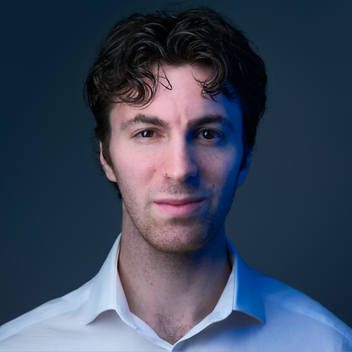
About Max
I am a…
Engineer
Bio
The idea for wanting to organize an event stemmed from my photography studio.
I shoot portraits on Strivers' Row. I've shot about 400 people in the last five years — actors, founders, neighbors. The thing about a portrait session is there's usually some time before the actual photo where the person sits down and starts talking. Usually they're working something out. Founders are figuring out how to pitch. Actors are figuring out which version of themselves to bring. Neighbors are working out the photo that might end up on a program someday. Part of the time I'm adjusting the lights. Most of the time I'm just listening and observing.
After about a year of this, I noticed that a lot of what I was hearing was basically TED talks. Real ideas, from people who lived within a ten-minute walk of my door. It started to feel kind of weird that I was the only one hearing them.
This event is about getting those ideas out of my studio and onto a stage.
One honest thing. I don't know every important person on Strivers' Row. I know some of them. I live here, I volunteer at Abyssinian, production companies call me. But the real knowledge of who's doing what on this block right now are in the people who've been here a lot longer than me. My landlord Marilyn probably knows better than I do. That's part of why this event has a curation board and an open application. The speakers have to come from a real search, not just the people I already know.
I thought about other formats such as a podcast or a community night. However, a podcast would catch the conversations but wouldn't make people actually tighten a talk. A community storytelling night would be warm, but the talks wouldn't go anywhere after. TEDx forces six to fourteen minutes, and the video keeps the talk alive after the event.
I'm passionate about
I graduated from Bucknell with a degree in engineering. I worked in construction management for a year after that and didn't like the politics or the people. I left and started my own photography studio, Glacier NYC. That's been my work for the last five years. I still know how the brownstones on my block are built, and I can tell you why they've held up for 130 years when some of the newer stuff uptown probably won't.
One thing I notice on Strivers' Row that most people wouldn't is that the buildings here are a little shorter than the brownstone blocks on the Upper West Side. Seems like a small thing but it's not. Shorter buildings let more light down into the street and you can feel the difference when you walk down the blocks.
The corner I come back to most with my camera is 138th and Frederick Douglass (partly because my laundromat and my grocery store are on that corner). I've shot the buildings there in every light and weather condition: midday, sunset, cloudy mornings, early evening, snow, rain. The road got repaved last year and looks better now. The buildings themselves haven't changed.
Out of my home studio, I've photographed headshots for about 400 people in the last five years. They were actors who were getting ready for an audition. A founder who was fundraising and needed marketing assets. My neighbors. Half the job is lighting and framing while the other half is talking to the person. I have to have my lighting, framing, and photography skills down and muscle memorized in order to focus on the subject 100 percent during the session. Getting the shot is all about getting the subject to forget that they are in front of a camera.
That's what I bring to TEDx. I live on the block, I volunteer in the community every week, I'm the person on the block people call when outsiders show up, and I've spent five years in my studio getting people to drop the stiff version of themselves and act normal in front of a camera. It’s only natural that a live stage makes sense for the next step.
An idea worth spreading
Kevin's research says people dim in two ways. Some shrink. Others put on armor, and plan to make no mistakes, ever. Both are dimming, and both are a constant tax on the nervous system that compounds over time. Kevin's argument is that "bring your full self to work" isn't actually the fix. The fix he proposes is writing what he calls a user's manual — figuring out which parts of yourself to bring into a given room, when, and being clear about who's allowed to do the editing. He has a four-part framework under it (Safety, Relational Risk, Connection, Light) and a concept he calls “the original room.” That's the place a person first learned that being fully themselves wasn't safe, and every professional room they walk into after that is getting read through it. The line the talk comes back to: "Don't bring your whole self to work. Bring the relevant edition. And know who owns the editing. This is one of the talks you will see at this year's TEDxStriversRow.
Areas of expertise
Photographer
The TED story
I kind of do speaker coaching for a living.
Everybody who sits down in my studio for a portrait goes through the same thing. They show up stiff. They don't know what to do with their hands. They're doing a flat, performed version of themselves because there's a camera in the room. My job is to get them off that and into something that actually looks and sounds like them.
The way I do it is mostly by casting. I'll throw a character at them and see what sticks — "You're the Gap ambassador." "You're Jake from State Farm." "You're presenting a bottle of wine to the royals." Sometimes the character lands and their face changes. Sometimes it doesn't and I try a different one. After five years and about 400 clients I've gotten pretty good at figuring out which character is going to get a particular person unstuck.
I also teach small tricks with names. I have a jawline trick, an eye trick, etc. I tell people what to do with their body, I show them the difference on the screen, and they trust the process a little more every time.
I also coach power. I've actually told clients, "You're looking down at me. That's how you should feel. We want to give you power in the image." Somebody who feels rooted in the room takes a different photo than somebody who feels exposed. Same thing on a stage. If a speaker feels exposed, the talk sounds exposed. Part of the job is getting them rooted before they open their mouth.
One more thing I do that I think will help. I tell the client the method out loud — "We take our time to get it right before we get going, so the shots are great." That sounds obvious. It isn't. Clients actually slow down when they can hear me slowing down. TEDx speaker prep is a bigger deal than a portrait session, but the pattern's the same.
So TEDx coaching isn't exactly the same job, but it's close enough that I'm not starting from zero. When a speaker shows up at their first session stuck in their boring meeting voice, the problem is the same one I solve every Tuesday. They're performing. I need them to stop.
Things you might not know
I like how buildings stand up. That was my reason for studying engineering in the first place. I can look at an old brownstone and figure out most of the reasons it's still standing — and most of the reasons the new stuff across town probably won't be in 50 years. I still find that interesting.
What I actually do for work now is shoot portraits. About 400 people in the last five years — actors, founders, neighbors.
What I've noticed is that in the first ten minutes of a shoot, most people are kind of performing. They don't know what to do with their hands. They give you a weird smile. By the second outfit they're acting like a normal human being again. That's the part I like. That's when the photo actually happens.
What I'm into, I guess, is the question of what has to be true for somebody to stop performing. Sometimes it's the room. Sometimes it's the light. Sometimes it's that somebody else sat down first and did the awkward part, so they don't have to. A TEDx stage is a bigger version of the same problem, and this event is kind of me trying to figure out the answer on a bigger scale.