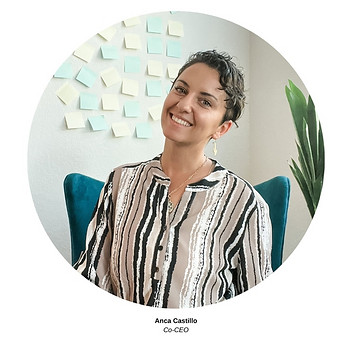
Anca Castillo
Co-CEO & CO-Founder at Design Convo LLC
TEDx Organizer
Chandler, Arizona, United StatesAbout Anca
I am a…
Artist, Change agent, Connector, Consultant, Designer, Entrepreneur, Event planner, Idea generator, Parent, Performer
Bio
Anca Castillo is a human-centered designer, collaboration strategist, and executive coach who helps leaders navigate the messy reality of working together.
As co-author of The Collaboration Illusion: Why Working Together Sucks and How to Fix It, Anca challenges the myth that collaboration is naturally good—and instead shows why it’s often frustrating, inefficient, and filled with hidden dynamics like power, ego, and misalignment.
Through her work with organizations across higher education, healthcare, government, and industry, she designs experiences that help people think differently, listen more deeply, and communicate with clarity. Her approach blends research, storytelling, visual thinking, and applied improvisation to build the skills leaders actually need—but were never taught.
Anca is also the co-founder of DesignConvo and the Improv Academy, where she helps professionals build confidence, navigate ambiguity, and lead without a script.
I'm passionate about
I’m passionate about helping people work better together—especially when it’s hard.
The moments that matter most in organizations are often the most uncomfortable: disagreement, uncertainty, competing perspectives, and high-stakes decisions. Yet these are the exact moments most people feel unprepared to navigate.
I care deeply about equipping leaders with the tools to handle those moments with clarity, curiosity, and courage.
I’m also passionate about bringing more humanity back into leadership—through storytelling, play, and real connection. Whether through applied improvisation, visual thinking, or facilitated dialogue, I believe learning should feel engaging, reflective, and alive.
An idea worth spreading
Collaboration isn’t broken—we just never learned how to do it.
We’ve been taught to value collaboration as the gold standard of teamwork, yet most of us have never been taught how to collaborate well. Instead, we rely on assumptions: that alignment equals agreement, that more voices lead to better outcomes, or that good intentions are enough.
The reality is that collaboration is full of invisible forces—power dynamics, competing priorities, fear of conflict, and unclear communication—that quietly derail even the smartest teams.
If we want collaboration to work, we have to stop treating it as a mindset and start treating it as a skillset.
When we learn how to listen deeply, surface assumptions, navigate tension, and communicate with intention, collaboration shifts—from frustrating and performative to productive and human.
Areas of expertise
Adult Learning, Applied Improvisation, Collaboration, Human Centered Design, Leadership Development, Performance, Pitch presentation, Process Improvement, Public Speaking, Strategic Storytelling, Teamwork
The TED story
I’ve always been drawn to moments where an idea lands in a way that changes how you see something and you can’t quite go back to thinking the same way again.
The first time I experienced that through TED was watching Do schools kill creativity? by Sir Ken Robinson. Having grown up as a dancer and a theater nerd, I was struck by how provocative the ideas he was sharing was and how seen I felt in that moment. Specially with that last story he shared about the little girl who grew up to a principle ballet dancers. From that Talk on, I was hooked.
From there, I kept going. I watched How being busy makes you less productive by Darria Long, which challenged the idea of being “crazy busy” in a way that stayed with me. Then talks on sleep and what happens in the brain—each one offering a new lens into how we live, think, and function. At some point, it stopped being occasional and became something I returned to constantly.
I’ve now watched well over 250+ TED Talks, not just for the content, but also to understand how ideas are shaped, communicated, and made meaningful to an audience.
That curiosity naturally connected to my own work. As someone who facilitates conversations and supports others in expressing ideas clearly, I’ve seen firsthand how powerful it can be when someone finds the right way to share an idea or insight.
Over time, I’ve also begun engaging more directly with the TED community—attending TEDx events locally and continuing to learn from how these experiences are curated. I am now fufilling a lifelong dream to attend a global TED Conference by registering to attend the TEDAI conference in Vienna, which feels like a meaningful next step in experiencing how ideas are shared at a global level.
For me, TED has never just been about great talks. It’s about the intentional shaping and sharing of ideas that have the potential to change how people think, act, and connect. That belief is what draws me to TEDx and the opportunity to help bring those kinds of ideas to life within my own community.
Things you might not know
Before this work, I spent over 16 years as a professional dancer and performer, traveling and performing around the world.
On paper, it looks completely unrelated to what I do now.
But it’s actually at the core of everything.
Dance taught me how to read a room without words. How to feel energy shift. How to communicate something real without over-explaining it. How to be fully present, responsive, and connected to an audience.
Today, I use that same instinct in a very different kind of stage.
Whether I’m speaking, facilitating, or working with leaders, I’m constantly paying attention to what’s being said—and what isn’t. Where people are engaged, where they’re holding back, where something isn’t landing.
Because communication isn’t just about words.
It’s about presence, timing, and connection.
And in many ways, I never stopped performing—I just changed the stage.