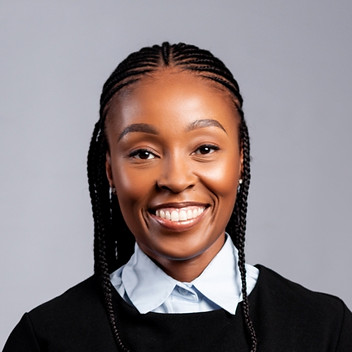
About Rapelang
I am a…
Activist, Entrepreneur, Technologist
Bio
Rapelang Rabana is Co-CEO of Imagine Worldwide, a Pan-African non-profit providing tablet-based learning programs in public primary schools, that enable almost a million children a year to develop foundational literacy and numeracy skills. Backed by a strong body of evidence, Imagine’s programs are proven to deliver top-quartile learning gains. Imagine plays the role of a system catalyst, bringing together all the pieces that make edtech scalable in low-income countries in Africa, and works in partnership with the Governments of Malawi, Sierra Leone, and Tanzania for long-term operational and financial sustainability. Today, Imagine is serving nearly one million children, and by 2030, the goal is to reach 4 million learners annually.
Rapelang has deep technology industry expertise and a visionary mindset, along with an unwavering commitment to education and skills development in Africa. Rapelang is the Founder of Rekindle Learning, a tech-enabled firm building workforce capabilities that translate into measurable business performance. Rapelang has 20 years’ experience building digital solutions, from her first startup right after university to becoming the Chief Digital Officer at one of South Africa’s largest IT companies. Rapelang has served as a member of the World Economic Forum Global Future Council on Entrepreneurship, as a trustee of the Standard Chartered Bank Botswana Education Trust, and as a board member for African Leadership University. She was featured on the cover of Forbes Africa magazine, named Entrepreneur for the World by the World Entrepreneurship Forum, and selected as a Young Global Leader by the World Economic Forum 2017. She holds a B. Business Science (Computer Science Honours) and an M.Sc from the University of Cape Town and lives in South Africa.
I'm passionate about
Proving that fit-for-purpose digital technologies, contextualized for the African context, can be scalable, sustainable and effective - more so than any traditional approaches. Many of the challenges we see in Africa were solved long ago in WEIRD (Western, Educated, Industrialized, Rich and Democratic) countries, before the advent of digital technology. Typically, they were solved using analogue solutions, and even if things weren’t perfect, they worked well enough for everyone to forget the flaws. Ironically, this has the effect of making inefficiencies less visible, and therefore provides less of an incentive for the adoption of innovative digital solutions. This ‘noticeability’ puts African innovators ahead of the curve.
This is what gives African innovators an advantage. We can look back at these limited, "good enough" historical solutions, and we can see their deficiencies and inefficiencies. Africa is in a position to solve its challenges using exponential technologies, and applying ‘experiential wisdom’, create solutions for problems that are not, at least initially, prioritized in WEIRD countries; and in doing so, it can leapfrog what exists. The African context provides the most fertile ground in which to innovate, because it is where these problems are most deeply felt, and are big enough both to motivate investment and deliver high return on impact.
An idea worth spreading
The same feedback loop that makes a great musician, a great athlete, a great philosopher is exposure, practice, attempt, feedback, and repeat. This has been out of reach for hundreds of millions of children across Africa who do not become literate and numerate by the age of 10. Not because they lack ability, but because they lack access to quality foundational learning.
In under-resourced classrooms from Cape Town to Freetown, children sit through lessons without fully knowing where they went wrong or right. Some receive marks without meaning. Others progress without a strong foundation. And a continent's potential quietly compounds in the wrong direction.
Adaptive learning technology changes the game. It offers every child what only the most privileged have ever had: consistent quality instruction, practice, attempt, feedback, and a learning experience that adapts to them not the other way around. No teacher shortage can defeat it. No overcrowded classroom can dilute it.
What's more, we are no longer guessing. The evidence is in - 9 randomized control trials show top-quartile results, compared to other education interventions. The results are measurable and staggering. The Governments of Malawi, Sierra Leone and Tanzania has committed to nationwide adoption.
Africa does not need to wait. The technology exists, implementation models proven, the proof of impact exists, and the will is rising to match the moment. Close the feedback loop, and you don't just improve a test score. You transform a generation.
Areas of expertise
Africa, Digital Technology, Education, Innovation, Skills
The TED story
In 2013, I did my first TEDx talk at TEDxCapeTown. In 2022, I applied for the TED Idea Search: Africa. I didn't make it. So being here and speaking at TED2026 feels like a full-circle moment. Watching my old application video, I couldn't help but feel the strange power of manifestation.
I also felt, if I'm honest, a little bored. Because I have been saying the same things, and working on the same things, for a very long time. Fit-for-purpose innovation can transform my continent. Closing the feedback loop. Building skills and capability at scale. Democratizing access. The mission hasn't changed much over 20 years. I guess it takes... as long as it takes. And there is still so far to go.
All innovation fascinates me. But my heart is in education. I had a privileged education, yet despite that, I often wondered about some of the inefficiencies in my learning process. After a test, I would briefly look at the script. I would browse through the ones I got wrong and silently promise myself to look over them again at some point, but that rarely ever happened. Some of the questions I got right, I would look at with surprise and be silently grateful for my luck. It was generally hard to keep track of the parts I got wrong or relied on dumb luck to get right, so I would just forget about it altogether.
I grew to learn that the inefficiencies I spotted in my own schooling were just the tip of a big iceberg! In the classrooms of Langa, an impoverished township on the outskirts of Cape Town, tutored high school kids math. What struck me most wasn't how much the children were struggling. It was why. They weren't getting feedback. Not real feedback. After tests came back, they would just get mark, just a number and nothing else. No indication of where they'd gone wrong. No indication of where they'd gone right. How do you improve when you can't see your own mistakes?
That experience cemented something for me: closing the feedback loop is quintessential to learning outcomes. The opportunity to practise, to attempt, to be told yes, keep going or no, try again that is the basis upon which anyone gets good at anything. Personalized learning solutions offer exactly that: unlimited practice, unlimited feedback, at a scale no classroom teacher can match.
That conviction let me start Rekindle Learning over a decade ago, and is what drew me to Imagine Worldwide. The catalytic moment came when the Government of Malawi committed to partner with us, to drive the nationwide adoption of our tablet-learning program. I had spent years on local and global platforms in front of corporate leaders, ministers, presidents preaching the power of technology. They always agreed it was nice. But when it came to the continent's most pressing challenges, they always defaulted back to the good old way of doing things. Pilots came and went. Nothing scaled. I had started to lose hope that African countries would ever move beyond the pilot phase and adopt innovative solutions at mass scale.
Imagine changed all of that for me.
Things you might not know
There are a few things I’ve come to recognise as strengths, even if they’re not always visible on the surface. Speaking is one of them. I've accepted that I have a natural ability to communicate ideas clearly and engage an audience. It’s something that now feels intuitive, but it’s also been shaped over two decades, through experience.
I also have a deep appreciation for wine. After 14 years in Cape Town, I’ve developed a strong understanding of it, beyond casual interest. It’s an area where I would really like to get even better. On a more personal note, I’m a really great aunt to my nieces. It’s a role I take seriously, and one where I show up with intention, care, and consistency.
It took me a while, but I am very much into hot yoga (the traditional 26 poses). It invigorates me like nothing else, and I even teach it sometimes.