About Aryan
I am a…
Athlete, Concerned citizen, Event planner
Bio
I’ve always been someone who asks “why?” before accepting “that’s just how it is.” I’m curious about people, ideas, arguments and especially the decisions that shape the world around us. That curiosity eventually led me towards international law, diplomacy, public speaking and leadership — areas where there is rarely just one simple answer.
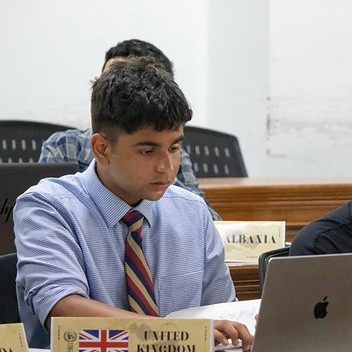
A huge part of my journey has been Model United Nations. I initially entered MUN because I loved debating, arguing my case and, admittedly, the competition. But somewhere between researching international disputes, studying different countries and defending positions I didn’t personally agree with, it became much more than that. MUN taught me that a good argument isn’t just about speaking confidently; it’s about understanding the other side well enough to question your own. It has taken me from sitting behind a country placard as a delegate to helping organise conferences and creating opportunities for other students to experience that same excitement of having their ideas heard.
Outside conferences and classrooms, sports have shaped a completely different side of me. Competing in basketball, handball, skiing and ice skating has taught me discipline, teamwork and how to deal with both winning and losing. There’s something about competition that constantly reminds me that improvement doesn’t happen overnight — you show up, make mistakes, learn and come back better.
International law is where I eventually hope to take this curiosity further. I’m fascinated by the relationship between law, diplomacy and global politics, particularly what happens when different countries, interests and interpretations collide. I enjoy questions where there isn’t an obvious answer because those are usually the ones that lead to the most interesting conversations.
And that is exactly what TEDx represents to me.
I don’t see TEDx as simply a stage, a red circle or a collection of impressive speeches. I see it as a place where one person can walk into a room believing something and leave questioning it. A place where an experience can become an idea, and an idea can become a conversation that continues long after the event ends.
I'm passionate about
I’m passionate about the things that make me feel completely involved — whether that means standing behind a country placard defending an argument, being on a basketball court with seconds left on the clock, discovering a legal case that sends me down a two-hour research rabbit hole, or working with people to turn an idea written on paper into something real.
International law and diplomacy fascinate me because they sit in a world where there is rarely a perfect answer. I love understanding why countries act the way they do, how law attempts to create order between competing interests, and how a single argument or decision can have consequences far beyond a courtroom.
But I’m equally passionate about competition, sports, leadership and conversations with people who see the world completely differently from me. I enjoy challenging myself, being challenged by others and constantly finding something new to learn.
More than anything, I’m passionate about curiosity — that feeling of discovering something interesting and immediately wanting to know what comes next.
An idea worth spreading
What if being wrong was actually a good thing?
We grow up in a world that rewards us for having the right answer. In classrooms, competitions, debates and even everyday conversations, being right feels like winning and being wrong feels like losing. But some of the most important things I have learned began with discovering that something I strongly believed was incomplete, misunderstood or simply wrong.
I think we need to become more comfortable with questioning ourselves. Imagine conversations where the goal wasn’t to defeat the person sitting across from you, but to leave knowing something you didn’t know before. Imagine if changing your opinion after hearing a better argument was seen as intelligence rather than weakness.
We already have billions of people trying to make their voices heard. What we need just as much are people willing to listen, question and reconsider.
Maybe progress doesn’t always begin when someone finds the right answer. Sometimes, it begins when someone has the courage to ask a better question.
Areas of expertise
debating and public speaking, diplomacy, event organisation and competitive sports. I particularly enjoy researching global issues, international affairs, international law and understanding different perspectives on political and social questions. I also have experience working in teams, Model United Nations, organising student-led initiatives and turning ideas into structured events., student leadership
The TED story
My TED story really began at my old school, The Lawrence School, Lovedale. Being there taught me that education was never meant to stay inside four classroom walls. Some of the things that influenced me the most came from conversations, competitions, assemblies, people I met and opportunities that pushed me to think beyond what was written in a textbook.
Lovedale had a culture where students were constantly encouraged to participate, speak up, compete, lead and explore things outside academics. Being surrounded by that environment made me realise how powerful a school can be when it becomes more than just a place to study. It can become a place where ideas are actually discovered.
That stayed with me even after I left.
Over time, through MUNs, debates and my growing interest in international law and diplomacy, I became even more fascinated by the power of perspective. I met people who could completely change the way I looked at an issue through a single argument or conversation. It reminded me of what I had experienced at Lovedale — that sometimes one opportunity, one person or even one idea can change the direction in which you start thinking.
That is what eventually drew me towards TEDx. I wanted to be part of something that creates those moments deliberately: a platform where students don't just sit and listen, but leave questioning, discussing and thinking.
For me, being part of TEDx is also carrying forward something my old school gave me — the confidence to step outside the classroom, stay curious and take ideas seriously. Lovedale showed me the kind of environment in which young people can grow; TEDx gives me an opportunity to help create that environment for someone else.
Maybe one student will sit in that audience, hear one idea and remember it years later.
If that happens, I think the entire effort will have been worth it.
Things you might not know
I’m surprisingly good at going down rabbit holes. Give me one interesting question and I can somehow turn it into hours of reading, jumping from one case, event or idea to another until I’ve completely forgotten what I originally searched for.
It happens especially with history, law and international affairs. I might start by trying to understand one judgment and end up reading about the conflict behind it, the countries involved, another case it influenced and some completely random treaty mentioned halfway through. Half the information may never be useful, but I genuinely enjoy connecting all those little pieces.
I think that’s something people don’t immediately see about me. When something genuinely catches my attention, I find it very difficult to leave it at the surface. I need to know the story behind it, why it happened and, usually, what happened next.
Basically, I’m pretty good at turning one simple Google search into fifteen open tabs and a completely different question.