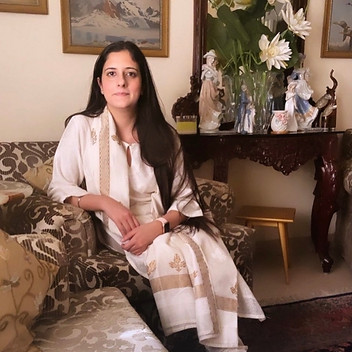
About Gayatri
I am a…
Artist, Brainstormer, Buddhist, Educator/Teacher, Idea generator
Bio
Gayatri Mehta is an experienced International Baccalaureate (IB) educator specializing in Economics, Global Politics, and Theory of Knowledge (TOK). With over eight years of experience across leading international schools in India, she is deeply committed to fostering critical thinking, ethical reflection, and global awareness in young learners.
Currently based at Strawberry Fields High School, Chandigarh, Gayatri teaches IBDP Economics, Global Politics, and Theory of Knowledge. Her teaching practice blends analytical rigor with real-world relevance, helping students connect economic systems, political ideas, and philosophical inquiry to contemporary global challenges.
In addition to her classroom work, Gayatri serves as a School Visiting Member with the New England Association of Schools and Colleges (NEASC), contributing to international school accreditation and quality assurance processes. She is also a long-standing IB Examiner — assessing Theory of Knowledge since 2017 and Economics since 2020 — a role that deepens her understanding of global academic standards and assessment integrity.
Previously, Gayatri taught at The British School, New Delhi, and Pathways School, Noida, where she also served as Student Council Coordinator, CAS Facilitator, and Model United Nations Club Mentor. Her leadership in these roles reflects a holistic approach to education, emphasizing intellectual growth, collaboration, and civic engagement.
Gayatri believes that education must go beyond content delivery — it should inspire inquiry, nurture empathy, and prepare students to participate meaningfully in an interconnected world. Through her dual work as an educator and examiner, she continues to advance the mission of international education: to empower thoughtful, ethical, and globally conscious learners.
I'm passionate about
I’m Passionate About Teaching for Understanding, Not Memorization
I’m passionate about helping students think, not just know. As an International Baccalaureate educator and Theory of Knowledge examiner, I’ve learned that real education begins when curiosity replaces certainty. In my classroom, I see learning not as the delivery of information but as the discovery of meaning. My goal is to help students connect ideas across disciplines, question assumptions, and see knowledge as something alive and evolving.
We live in a world overflowing with information but starved of understanding. Facts are easy to find; wisdom is not. That’s why I teach Economics, Global Politics, and Theory of Knowledge as lenses for thinking about humanity—how choices, ethics, and systems shape one another. When students realize that behind every statistic is a story and behind every decision a moral choice, they begin to see learning as a form of empathy.
I’m passionate about uncertainty because it forces us to think deeper. In my classes, I tell students that not knowing is not failure—it’s the beginning of inquiry. The ability to question, reflect, and adapt is what defines intelligence today. The future will not reward those who memorize answers but those who can ask better questions.
As an educator and examiner, I’ve seen that the best classrooms are not led by those who have all the answers but by teachers who keep learning. I strive to model curiosity, humility, and critical reflection. Every discussion, essay, or debate is a chance to explore ideas, not finalize them. Knowledge is never neutral; it carries ethical weight. I want my students to understand that information without conscience can divide, but knowledge guided by empathy can change the world.
True education, to me, is not about grades or exams—it’s about preparing young people to navigate complexity with confidence and compassion. I’m passionate about helping them connect economics with ethics, politics with philosophy, and knowledge with humanity. When students start making those connections, they stop seeing learning as an obligation and start seeing it as empowerment.
Ultimately, I’m passionate about nurturing thinkers, not answer-finders—students who can hold uncertainty without fear, approach difference with empathy, and act with integrity in a complex world. Because in a time when everything changes quickly, the most powerful skill is not knowing everything but being willing to keep learning.
An idea worth spreading
Teaching for Uncertainty: Why the Future Belongs to Thinkers, Not Answer-Finders
We live in an age where answers are instant and information is infinite, yet true understanding feels increasingly rare. As an International Baccalaureate educator and Theory of Knowledge examiner, I’ve learned that our biggest challenge is no longer ignorance—it’s the illusion of knowing. Students can “Google” any fact, but what they often lack is the ability to question it. My idea is simple but transformative: the most valuable education today does not prepare students for certainty—it prepares them for uncertainty.
Traditional education rewards correctness and speed, yet the future will belong to those who can think critically, adapt ethically, and learn continuously. In my classroom, I teach Economics, Global Politics, and Theory of Knowledge, but what I really teach is how to navigate complexity. I want my students to ask, “Who benefits from this policy? What values shape this decision? How do we know this is true?” Because learning begins where certainty ends.
In the Theory of Knowledge course, students often start believing that knowledge is about being right. Then they discover that every answer is open to challenge—that truth shifts with context, culture, and perspective. When they realize this, learning becomes an act of inquiry, not memorization. They stop fearing being wrong and start seeing doubt as the doorway to discovery.
Our world is uncertain—technologically, politically, environmentally—and education must evolve to meet that uncertainty with curiosity, not fear. The problems facing humanity—climate change, inequality, misinformation—cannot be solved by specialists working in isolation. They require interdisciplinary thinkers who can connect economics with ethics, science with philosophy, and innovation with empathy. Once students see those connections, they begin to see the world as a living system, not a list of subjects.
The role of educators must change too. We must model curiosity instead of certainty, show humility instead of authority, and guide students to build meaning instead of merely recalling it. The best classrooms I’ve visited as a NEASC school visiting member are led not by experts delivering facts, but by teachers learning alongside their students.
Knowledge, I remind my students, is never neutral. Every claim carries ethical weight. In Economics, we question who’s invisible in the data. In Politics, we analyze whose voices shape the narrative. Knowledge without empathy can divide, but knowledge guided by ethics can heal.
Education must therefore move beyond preparing students for exams; it must prepare them for complexity. We must teach them how to learn, not what to memorize; how to reason, not what to believe; how to question, not what to accept. The future will not reward those with all the answers—it will reward those who can keep asking better questions.
Uncertainty is not our enemy; it is our greatest teacher. It pushes us to imagine, adapt, and care. When we teach students to embrace uncertainty, we don’t just prepare them for change—we prepare them to lead it. The future belongs to thinkers, not answer-finders.
Because in a world overflowing with information, the true measure of intelligence is not what you know, but how deeply you are willing to wonder.
Areas of expertise
Art, Economics, Education, Epistemology, Politics, Theory of Knowledge, Writing
Things you might not know
People don’t know I’m an artist at heart — I love bringing ideas to life through acrylic and oil paintings.