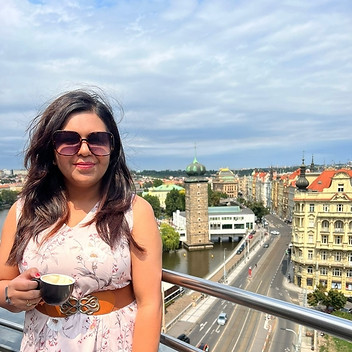
About Tulika
I am a…
Explorer, Hindu, World traveler
Bio
A teacher and a lifelong learner! I am an experienced English Language and Literature educator with over a decade of teaching across IB and Cambridge schools in Maharashtra.I hold a Master’s degree in English Language and Literature from Wadia College and am a trained IB and IGCSE professional. My expertise lies in curriculum planning, classroom management, and integrating AI in education, and I have consistently guided students to strong results in IGCSE, MYP, and DP examinations.
Beyond the classroom, I love traveling and hiking, and I’m also a proud cat mom! My teaching philosophy is centered on fostering critical thinking, empathy, and a genuine love for language and literature.
I'm passionate about
Language and Literature – exploring how stories shape perspectives and identities
Teaching and Learning – guiding students to think critically and creatively
Empathy through Storytelling – helping learners step into others’ shoes through texts
Curriculum Innovation – designing inquiry-driven, engaging, and meaningful units
Integrating Technology & AI – using modern tools to enhance education
Student Growth & Agency – empowering learners to discover their voices and potential
Travel & Exploration – experiencing new cultures and perspectives
Nature & Adventure – hiking, outdoor learning, and drawing life lessons from lived experiences
Companionship & Care – being a proud cat mom 🐾
An idea worth spreading
In a world overflowing with information but starved of understanding, stories remain one of the most powerful tools we have. As an English Language and Literature educator, I’ve seen firsthand how a novel, a poem, or even an advertisement can do more than entertain—it can open windows into lives vastly different from our own.
My idea is simple: if we teach students not just to analyze texts, but to truly inhabit them, we can cultivate empathy at scale. In the classroom, when a student walks in Scout Finch’s shoes, feels Tom Robinson’s fear, or recognizes themselves in a character from a distant culture, something shifts. They begin to see the “other” not as an abstraction, but as a human being.
This matters now more than ever. Artificial intelligence and digital tools are transforming how we read and communicate. Instead of fearing this change, I believe we can harness it—to make stories more accessible, to amplify marginalized voices, and to encourage students to co-create narratives that reflect our shared humanity.
My idea worth spreading is this: stories are not just mirrors of society—they are engines of empathy. And if we can teach the next generation to read, write, and live with empathy, we may just bridge divides that politics and policies cannot.
Things you might not know
Travel planning, Gardening and cooking