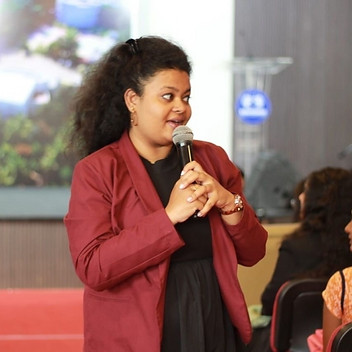
About ARUNIMA
I am a…
Educator/Teacher
Bio
Prof. Arunima Dey is a young and motivated Assistant Professor and UG Head of Journalism at Krupanidhi Degree College. She has been associated with the Krupanidhi Group of Institutions for the last three years.
Prof. Dey holds a Master of Arts degree in Journalism and Mass Communication, specializing in Audio-Visual Production, and possesses almost four years of experience as an Assistant professor. She worked as an Assistant Professor in Journalism at Jain University, Bengaluru.
Before indulging in the teaching profession, she worked with eminent Journalist P.Sainath in his organization PARI. Her clicked photographs of Rural India are featured on the PARI website. She has excessive knowledge of Photography and was awarded as 'Best Photographer' at Youth Fest. She worked with Mumbai International Film Festival, Film Division- Mumbai, and the International Association of Women for Radio and Television in New Delhi.
Additionally, she is research-oriented and published several book chapters and papers. Prof. Dey participated in Krupdacon International Conference 2022 and got the Best paper award as Co-Author. She also secured a third position in the Humanities paper presentation track.
Prof. Arunima Dey believes in personality development, professional development, and skill development. She guides the students to perform beyond the campus and makes them corporate-worthy. Her profound industry knowledge helps the students to achieve a better professional and social life.
I'm passionate about
I am extremely passionate about filmmaking, photography, writing research papers, and so on.
An idea worth spreading
One of the key reasons for including regional films in film studies courses is to expose students to a diverse range of cultures, traditions, and perspectives. Regional films are considered part of rural journalism.
The film is an influential medium that reflects and shapes society. By exploring regional films from different parts of the world, students gain insight into the nuances of various cultures, social issues, and historical contexts. It expands their worldview and encourages them to appreciate the richness and diversity of global cinema. Regional film industries, such as those in India, China, Nigeria, and Iran, have made significant contributions to the world of cinema. These industries produce films that are not only commercially successful but also artistically acclaimed. Including regional films in the curriculum allows students to study and appreciate the unique storytelling techniques, visual aesthetics, and narrative structures employed in these films. Students can learn about the distinctive film movements, genres, and influential filmmakers from different regions, thereby gaining a comprehensive understanding of the cinematic landscape.
Regional films often capture the essence of a particular culture, language, or community. They serve as a repository of cultural heritage and provide valuable insights into the history, customs, and traditions of different regions. By studying regional films, students can engage with the heritage of diverse communities, fostering an appreciation for cultural preservation and promoting intercultural dialogue. These films can be a powerful tool for understanding social issues, identity, and the struggles faced by marginalized communities.
Incorporating regional films into film studies curricula can also contribute to the growth and development of local film industries. By studying regional films, students are exposed to emerging talents, alternative filmmaking approaches, and the challenges faced by filmmakers outside the mainstream. This exposure can inspire students to explore their cultural heritage and contribute to their local film industries, fostering creativity and innovation.
The TED story
Incorporating regional films into the film studies curriculum creates a symbiotic relationship between academia and the industry. Students equipped with a comprehensive understanding of regional cinema become the next generation of filmmakers and scholars who can push boundaries, bring fresh perspectives to the global cinematic landscape, and contribute to the growth of their local industries.
Things you might not know
Training, Photography and filmmaking