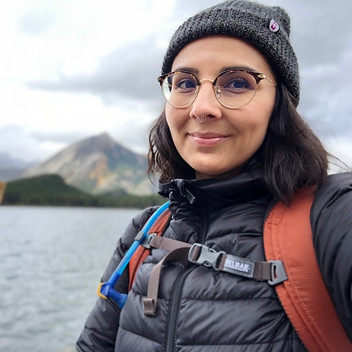
About Eriel
I am a…
Activist, Artist, Environmentalist, Parent, Writer/Editor
Bio
Eriel Tchekwie Deranger is a Dënesųłiné woman (ts'ékui), member of the Athabasca Chipewyan First Nation (Treaty 8) and mother of two, coming from a family of Indigenous rights advocates. Deranger is the Executive Director and founder of Indigenous Climate Action (ICA) - an Indigenous-led climate justice organization working to empower communities and inspire Indigenous-led climate solutions. ICA develops educational multi-media and contemporary climate change resources for Indigenous communities, amplifies our stories and supports Indigenous rights to sovereignty and self-determination.
In addition to her role as the Executive Director of ICA, she is an active member of the UN Indigenous Peoples Forum on Climate Change participating in UNFCCC COP and preparatory meetings. She also sits on the boards of Bioneers, It Takes Roots Leadership Council, Climate Justice Resiliency Fund Council of Advisors and WWF Canada; and was a founding member of the Global Indigenous Youth Caucus.
Deranger's work focuses building intersectional dialogue between Indigenous rights, climate justice and other social justice movements nationally and internationally. Her work and advocacy has taken her across the world where she regularly provides keynotes addresses on Decolonization, Indigenous Climate Justice, intersectional movement building and inspiring the global Indigenous community to step into their role as climate leaders. Her unique approach incorporates traditional storytelling, academic research including western scientific data and stunning visuals that draw people into the power narrative of Indigenous rights and climate justice imperatives.
Beyond this work Deranger is recognized for her role in creating one of the largest inter-sectional keep it in the ground campaigns: The international Indigenous Tar Sands campaign. Her work championed challenging the expansion of Alberta’s Tar Sands and developing the Tar Sands Healing Walk. As part of this campaign she was part of spring boarding one of the first Indigenous rights-based divest movements; and working to develop and lead mass mobilizations highlighting the mass inequity of the impacts the fossil fuel industry and climate change on the rights of Indigenous peoples. She became critical to bringing international recognition to issues in her territory with celebrities like Leonardo DiCaprio, Darren Aronofsky, Neil Young, Daryl Hannah, James Cameron and many others, drawing attention across the globe.
Deranger has written for the Guardian, Yellowhead Institute, The National Observer, Red Pepper Magazine; has been featured in documentary films including Elemental (2012); and is regularly interviewed for national and international media outlets including Democracy Now!, Aboriginal Peoples Television Network (APTN), and CBC.
I'm passionate about
Decolonizing the processes and policies created to address the climate crisis. We can't just work on stabilizing greenhouse gas emissions and treating the climate crisis from a reductionist frame that reduces it to a mathematical equation. When we approach the crisis like this we risk replicating the same systems of harm and oppression that contributed to the climate crisis in the first place. Instead, we must take a more holistic approach that looks at stabilizing our relationships with the land, Mother Earth in its entirety, and with each other.
While Indigenizing is about the inclusion of Indigenous peoples and voices within predetermined (colonial) constructs, while visibility and representation is an incredibly important part of this work, it is not decolonization. Indigenizing works to make Indigenous peoples, values, and knowledge visible in colonial systems. As such it maintains the centering of colonial systems, structures and power rather than shifting or relinquishing power (ie. government agencies hiring Indigenous peoples to determine how to address Indigenous sovereignty and self-determination).
Decolonization on the other hand requires an undoing and decentering of colonial lenses, processes, systems and power. It also requires work from all parties and is not a responsibility held by Indigenous peoples but is something we need to work collaboratively to achieve. Much like Indigenizing there is a need to understand the lived histories and experiences of Indigenous peoples where it diverges is in the steps that come afterwards. Apologies and Diversity and inclusion falls short of achieving decolonization, which requires colonial institutions to relinquish power, resources and processes as opposed to absorbing decolonial knowledge, systems, power and processes into their own which diminishes sovereignty.
An idea worth spreading
Building a decolonial movement servicing organization utilizing a bottom-up approach that takes the lead from our communities; their strengths, their needs, the resources available to them, and what they want to achieve in driving local, national, and international change. By amplifying Indigenous rights, worldviews, value systems, and ways of being we are investing in the seeds of the future and changing how we participate and lead as Indigenous peoples in the climate justice movement.
For many Indigenous peoples, climate change began at first contact and the onset of colonization and it is our rights, our ways of life that holds key answers to combating climate change. We know that climate justice demands more than protest or reduction of GHGs, it requires liberation from the root causes of planetary injustices. As a decolonial organization, we value Indigenous ways of being that invite radical imagination and space for creativity and exploration.
Indigenous climate leadership is a movement that ignites the power and rights frameworks that all Indigenous communities hold, to step into decision making spaces and demand necessary systemic change. By supporting our communities to imagine climate justice outside of colonial solutions, white supremacy, and economic industries that have caused, and continue to cause, irreparable harm to our lands, territories and rights, we can stimulate our ancestral creativity, knowledge and solutions that will move us towards a just future.
ICA's provide our communities with the necessary alternative to work with an Indigenous organization that understands their lived realities, and to change how our communities work, see themselves, and exist in today’s colonial environmental movements.
Areas of expertise
Climate Change, Climate Policy, Indigenous rights, International Indigenous rights and climate change, Intersectional movements, Treaty rights
Things you might not know
Drawing and painting