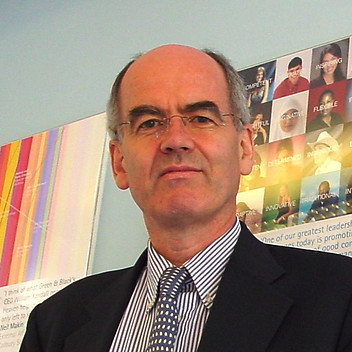
About John
I am a…
Change agent, Entrepreneur, Idea generator, Parent, Photographer, Potential employer, Social entrepreneur, Startup, World traveler, Writer/Editor
Bio
Born 1949 and raised in England, Northern Ireland and Cyprus. An environmentalist since 1961, when he raised money for the newly-launched World Wildlife Fund. Trained in history, economics, sociology and urban planning, at Bryanston School, the University of Essex and UCL. Inspired by the Whole Earth Catalogue, Buckminster Fuller, Frank Herbert and many others, experimented with alternative technology communities in the early 1970s, but then joined TEST (1974-78), writing extensively on environmental themes for New Scientist, before leaving to co-found Environmental Data Services (ENDS) Ltd in 1978 with Max Nicholson and David Layton.
A prolific coiner of terms, including 'environmental excellence' (1984), 'green consumer' (1986), the 'triple bottom line' (1994) and 'People, Planet, Profit' (1995). When he adopted the name SustainAbility for his new company in 1987, the term was scarcely used - though the launch of the Brundtland Commission's report, 'Our Common Future', that same years helped change that.
John remains on the Board of SustainAbility, which is based in London, Washington, DC, New York, San Francisco and Delhi. In 2008, he also co-founded Volans Ventures, based in London and Singapore, and is now Executive Chairman. Volans aims to find, explore, advise on and build innovative scalable solutions to the great global divides that overshadow the future.
John Elkington is considered a world authority on corporate responsibility and sustainable development. In 2004, BusinessWeek described him as “a dean of the corporate responsibility movement for three decades.” In 2008, The Evening Standard named John among the ‘1000 Most Influential People’ in London, describing him as “a true green business guru,” and as “an evangelist for corporate social and environmental responsibility long before it was fashionable.” In 2009, a CSR International survey of the Top 100 CSR leaders placed John fourth: after Al Gore, Barack Obama and the late Anita Roddick of the Body Shop, and alongside Muhammad Yunus of the Grameen Bank.
In terms of other hats, John is a Visiting Professor at the Doughty Centre for Corporate Responsibility at the Cranfield School of Management. He chairs The Foundation for Democracy & Sustainable Development and the Aflatoun Impact and Policy Analysis Steering Group and is an Honorary Fellow of The Hub and the Institute of Green Professionals. John is also a member of boards or advisory boards for, among others: 2degrees; Carbon Auditors (UCL), the Dow Jones Sustainability Indexes; EcoVadis; Gaia Energy; the Global Reporting Initiative; Instituto Ethos; Polecat UK and a Cleantech Fund developed by Zouk Ventures. He is a Senior Advisor to the Business & Human Rights Resource Centre, a member of the WWF Council of Ambassadors, a member of the Evian Group Brain Trust and Council of Global Thought Leaders, the Global Leaders Academy; and the Cleantech Group LLC’s Cleantech Innovation Council. John was a Faculty member of the World Economic Forum from 2002-2008.
Author of 17 books, including 1988's million-selling The Green Consumer Guide, his latest book, co-authored with Pamela Hartigan, is The Power of Unreasonable People: How Social Entrepreneurs Create Markets That Change the World (Harvard Business School Press, 2008).
I'm passionate about
Earth and Life. Family and Friends. History and the Future. Science and Technology. Business and Markets.
An idea worth spreading
The next decade will see radical, transformative, disruptive progress towards the Transparent Economy, albeit with growing islands and undercurrents of stealth. We will see hybridization between the worlds of Jaron Lanier (virtual reality), game designers, Google Earth, Dara O'Rourke and GoodGuide, the tsunami of apps, novel forms of mapping and visualization, and of triple bottom line accounting and reporting organizations like the Global Reporting Initiative and Accounting for Sustainability. The current reality of printed corporate reports and hyperlinked annual reports will seem as distant by 2025 as the Pony Express seems today. The collision between Google and China early in 2010 suggests that the transition will not proceed in a straight line, but then History never does.
The TED story
I knew of TED, of course: TED Board member Tim Brown is a member of the Volans Advisory Board. I viewed the clips people forwarded with more than passing interest. But it was only when I did a blog on James Camerson's 'Avatar' that a Facebook friend - Claudia Gonella - sent me a link to Bertrand Piccard's 2009 gig. The ballooning metaphor went in like a subcutaneous injection. Having recently left an organization I co-founded over 20 years ago to set up a new one, in the teeth of the downturn, his points about which ballast to drop and what altitude to seek made great sense. As did his line about finding motivation in what others see as impossible: That was what we were getting at in 2008's book 'The Power of Unreasonable People'. Like the flying scenes in 'Avatar', there was something about the flight metaphor which hooked me. The name Volans comes from the Latin for flying fish. We work with people who are the take-off point towards a new, more sustainable civilization.
Things you might not know
Sleeping. And dreaming.