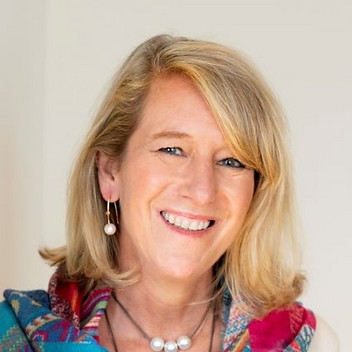
Elizabeth Funk
Founder and CEO at DignityMoves
TED Attendee
San Francisco, California, United StatesAbout Elizabeth
I am a…
Activist, Business leader, Business mentor, Change agent, Concerned citizen, Entrepreneur, Explorer, Global soul, Idea generator, Parent, Policy maker, Single, Startup, World traveler
Bio
Elizabeth Funk is the Founder and CEO of DignityMoves, a nonprofit she co-founded with fellow members of Young Presidents Organization (“YPO”) to address the crisis of homelessness. DignityMoves works to end street homelessness in our communities by building interim supportive housing with rapid, cost-effective, scalable solutions.
Elizabeth Funk’s career blends Silicon Valley high-growth start-up entrepreneurship with innovative impact initiatives that align for-profit and nonprofit approaches to accelerate positive social impact outcomes.
Elizabeth was one of the early pioneers in impact investing, founding the Dignity Fund in 2004. One of the first for-profit funds mobilizing investment capital for the microfinance industry, her fund demonstrated the benefits of harnessing capitalism to accelerate an industry that had previously been driven by philanthropy and the public sector.
At the same time, she served as Chairman of the Board of Unitus, a nonprofit that was one of the world’s most innovative microfinance accelerators. Through these simultaneous roles, Elizabeth developed a deep understanding of the relative roles nonprofit and for-profit approaches play in accelerating impact. Elizabeth continued her impact investing journey as Senior GP of Dev Equity, investing in companies that foster poverty alleviation, including several developers of low-income housing in regions across Honduras, Nicaragua, Panama, Costa Rica, Peru, and Ecuador.
Elizabeth started her career in product design, marketing, and business development as a Product Manager for Microsoft Word and was part of the founding team of Microsoft Office. In 1995, as one of the earliest employees at Yahoo! she helped shape the early consumer internet with services such as Yahoo! Finance, Search, Auctions, Greetings, Travel, and others. Most notably, Elizabeth was behind the creation of Yahoo! Shopping, a forerunner to the booming sector now known as e-commerce. Later she served as the President and CEO of CML Global Capital, a publicly-traded investment conglomerate with holdings in Hong Kong, Canada, and Belize.
Elizabeth currently serves as the Chairman of the Board of Peak Power a climate technology company at the forefront of the energy transition. Elizabeth has served on or chaired over a dozen nonprofit and social enterprise boards including South Pacific Development Bank, Uchu (Ecuador), Candid, Root Capital, Ujjivan Small Finance Bank, Deutsche Bank’s Microfinance Consortium and FINCA’s microfinance fund.
She is an active member of Young Presidents Organization where she served as the Pacific Regional Chair and then on the YPO International Board, co-founded the YPO Impact Networks, and now chairs the YPO Impact Investing Initiative. She is a member of Toniic (an impact investors network) Battery Powered, Campden Wealth’s Institute for Private Investors, among many other prominent impact-focused organizations.
Elizabeth holds an undergraduate degree in International Relations and Economics with Honors from Stanford University and an MBA from Harvard Business School as a Baker Scholar.
I'm passionate about
Ending homelessness. In such a wealthy country as the United States, it is simply unacceptable to allow this humanitarian crisis to continue on our streets. I'm doing something about it!
An idea worth spreading
We need to fundamentally change the way we think about addressing homelessness in our country. This crisis has grown to epic proportions; it is truly unacceptable to have people sleeping on the streets in one of the wealthiest countries in the world. We have decoded the human genome and sent men to the moon but we can't figure out how to get roofs over peoples heads? I refuse to accept that. The only thing standing in our way is outdated thinking and bureaucracy. In California the powers-that-be in the homelessness system firmly cling to an outdated paradigm: that any money we spend on anything other than permanent housing is a waste of resources. While the goal of providing a studio apartment with granite countertops to anyone experiencing homelessness is a noble goal, it is fundamentally unattainable. No calculators go that high. Its costing over $800,000 PER UNIT (more in big cities) and takes at least 5 years. The result? 72% of people experiencing homelessness are literally unsheltered, languishing on waiting lists. In San Francisco the average wait is 14 years. Our streets cannot be the waiting room! The only alternative is group shelter, and people don't want to go. I wouldn't. They prefer a tent than sleeping next to strangers who snore, rifle through their duffel bag, or worse. My organization, DignityMoves, started with the premise that these are PEOPLE-- real humans, not trash to sweep away down the street. Every one of them is somebody's something (mother, child, classmate, teacher, friend). They have fallen on hard times and likely experienced quite a bit of trauma. Maybe they have escaped an abusive relationship, maybe they have been kicked out of the house when they "came out" to their parents for being gay. Or maybe the color of their skin limited their economic opportunities (and their parents', and grandparents'). I believe that we need to invest in "interim supportive housing" where everyone gets their own room with a door that locks. A place to take a deep breath. The private room is a game changer: when an outreach worker goes to an encampment to offer a bunk bed in a shelter, they are lucky if 1 out of 10 will accept it. When offered a private room, no one turns it down. The private room is the "lure" to get them to come -- so that the real magic can happen, supportive services. When people are on the streets they are in survival mode. We learned in 8th grade science that "fight or flight" and adrenaline literally redirects the blood from the rational parts of the brain to the survival instincts. Its biologically impossible as well as logistically impractical to expect people to solve their problems while surviving on the streets worrying about being assaulted or where they'll find their next meal; much less without a shower and internet. Interim Supportive housing can be built quickly and inexpensively with emergency building codes, and set up on vacant parking lots. Once stabilized, people are finally in the mental and emotional frame of mind to start thinking forward. With the help of staff they can get enrolled in government funding programs (Medi-Cal, disability), get their drivers license or other legal ID, get on waiting lists for vouchers, and maybe even write a resume. But interim supportive housing is also effectively a sorting mechanism. Some people can now resolve their core issues; some can reunite with family, others find a job in a less expensive city. Of course some will indeed need government-funded permanent housing but they'll be more ready for that, after a few months of relearning stable patterns. I was shocked to learn that our stigmas and preconceptions about people experiencing homelessness were fundamentally flawed. When people first experience homelessness, the vast majority do not (yet) have a serious mental health or substance abuse problem. 30 days after surviving on the streets, their chances of having a lifetime (and sadly, possibly incurable) mental health or substance abuse problem have skyrocketed. Policies that leave people to suffer (and die) on the streets for 14 years are responsible for creating, or at least massively exacerbating, the very problem they are designed to solve. If we have enough dignified interim housing for everyone who needs it, many of them will self-resolve (perhaps even become tax payers) and in the end we'll need far less government-funded Permanent Supportive Housing.
The definition of insanity is doing the same thing over and over, hoping for a different result. Whatever we have been doing to address homelessness clearly isn't working; we are spending more and more money yet the problem keeps getting worse. It's time for Silicon Valley-style disruptive thinking. The problem has become so horrendous that people seem to have given up. "It's just the way it is" or "there's no way to solve it." I disagree. we need optimistic "let's just make it happen" thinking, and the will to do it.
Areas of expertise
Business Development, Entrepreneurship, Impact Investing, Strategy
Things you might not know
Organizing! I love keeping all of my drawers, cabinets, closets, and garage shelves tidy and organized. On days when life feels especially chaotic, I guess I find an odd solace in having one small aspect of life completely orderly and in control.